
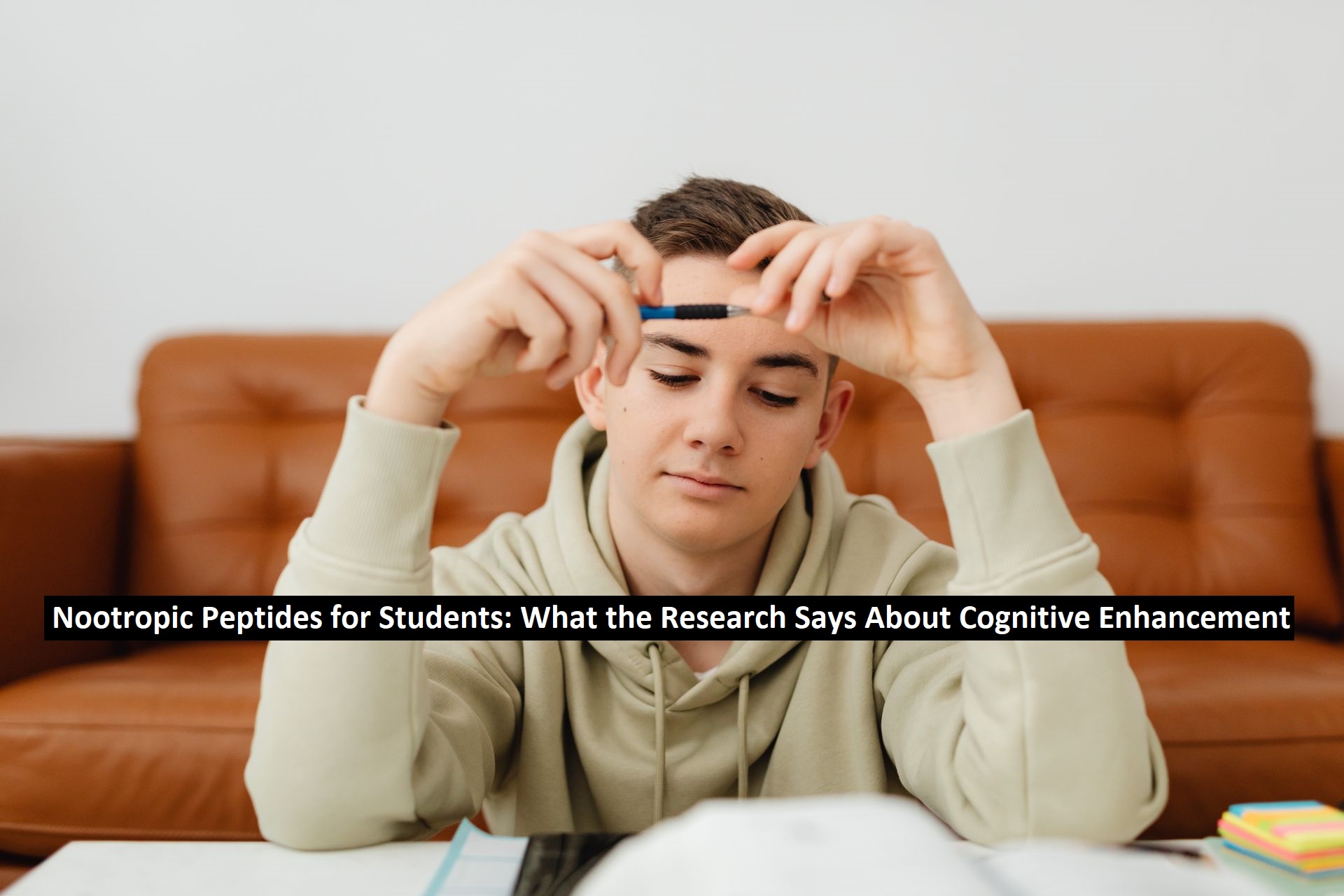
Nootropic Peptides for Students: What the Research Says About Cognitive Enhancement
Did you know that the global nootropics market is projected to reach over $30 billion by 2028? Behind that staggering number is a growing population of students, researchers, and professionals searching for an edge — better focus, sharper memory, calmer nerves under pressure. For decades, that search has centered on caffeine, prescription stimulants, and herbal supplements. But a newer category of compounds is drawing serious scientific attention: nootropic peptides.
If you have heard the terms “Selank” or “Semax” floating around study forums and biohacking communities, you are not alone. These short-chain peptides, originally developed in Russia over the past several decades, are being discussed for their potential cognitive and mood-regulating effects. But what does the actual research say — and more importantly, what should students understand before exploring this space?
Here is what the research says — and why a research-first mindset matters.
What Are Nootropic Peptides?
Peptides are short chains of amino acids — essentially mini-proteins — that occur naturally in the body and regulate everything from hormone release to immune function. Nootropic peptides are synthetic or naturally derived peptides studied for their effects on cognition, mood, and stress resilience.
Unlike caffeine or amphetamine-based stimulants, which primarily work by increasing dopamine and norepinephrine activity, nootropic peptides are thought to interact with more specific neurological pathways. Some influence brain-derived neurotrophic factor (BDNF), a protein involved in neuroplasticity and memory formation. Others modulate neurotransmitter systems tied to anxiety and emotional regulation.
This mechanism distinction is critical. Traditional stimulants increase arousal — making you feel more awake, often at the cost of jitteriness, crashes, and sleep disruption. Nootropic peptides are being studied for gentler, more targeted effects without the classic stimulant crash.
Selank: Anxiety Reduction During Exams
Few experiences are as universally familiar to students as pre-exam anxiety. The racing heart, the blanking mind, the sweaty palms — these are stress responses wired into the human nervous system. Research on Selank, a synthetic peptide derived from the naturally occurring peptide tuftsin, has explored its potential as an anxiolytic — an anxiety-reducing compound.
Russian pharmacological studies from the early 2000s investigated Selank for generalized anxiety disorder and found that it may reduce anxiety symptoms while preserving cognitive performance. Unlike benzodiazepines, which can cause drowsiness and cognitive blunting, Selank appears to modulate anxiety-related neurotransmitters without significant sedative effects. A 2010 study in Bulletin of Experimental Biology and Medicine suggested that Selank influences the expression of genes involved in neurotransmitter metabolism.
For students, the theoretical appeal is obvious: a compound that reduces anxiety without dulling focus. However, most Selank research has been conducted in Russia, and large-scale, placebo-controlled clinical trials in Western medical settings remain limited. Students interested in learning more about the Selank peptide should approach the existing literature with appropriate skepticism and curiosity.
Semax: Focus and Memory Enhancement
If Selank addresses the emotional side of academic performance, Semax targets the cognitive machinery itself. Developed at Moscow State University in the 1990s, Semax is a synthetic peptide derived from adrenocorticotropic hormone (ACTH). Its primary research interest lies in memory enhancement, attention, and neuroprotection.
Several Russian studies have explored Semax for its effects on attention and memory consolidation. A study in the Journal of Psychopharmacology and Experimental Substance suggested that Semax administration increased BDNF levels in the hippocampus — the brain region central to learning and memory. Higher BDNF expression is associated with improved synaptic plasticity, the process by which the brain forms and strengthens neural connections during learning.
For students pulling long study sessions, enhanced neuroplasticity is appealing. If the brain forms stronger neural pathways during study, retention and recall could theoretically improve. Students researching the Semax peptide should understand, though, that most of these findings come from animal models and small human trials. Broader clinical validation in Western institutions is still in early stages.
Epithalon: Longevity and Cognitive Aging
While Selank and Semax address acute cognitive performance, Epithalon occupies a different space — the science of aging. Epithalon is a synthetic tetrapeptide studied for its effects on telomerase activation and cellular senescence. Telomeres are protective caps at the ends of chromosomes that shorten with age, and telomerase is the enzyme that can lengthen them.
Research by Russian scientist Vladimir Khavinson over several decades suggested that Epithalon may activate telomerase, potentially slowing cellular aging. A 2003 study in Bulletin of Experimental Biology and Medicine reported extended lifespan in mice treated with Epithalon.
For students of cognitive science, this raises fascinating questions about the relationship between biological aging and cognitive decline. If neurodegeneration is partly a function of cellular aging, compounds addressing telomere shortening could, in theory, preserve cognitive function into later decades. However, the leap from mouse studies to human applications is substantial, and no large-scale human trials have confirmed longevity benefits.
Read: Tips To Get Victory In Understudy Life
Nootropic Peptides vs. Traditional Stimulants
Caffeine, the world’s most consumed psychoactive substance, works by blocking adenosine receptors. This prevents the feeling of fatigue but does not reduce the body’s need for rest — often resulting in a short-term boost followed by a crash. Prescription stimulants like amphetamines increase dopamine and norepinephrine release, improving focus but carrying risks of dependence, tolerance, and cardiovascular strain.
Nootropic peptides appear to work through more targeted pathways — modulating neurotrophic factors, influencing gene expression related to anxiety, and potentially supporting neuroplasticity. They do not produce the acute arousal of stimulants. Instead, the research suggests subtler, longer-term effects on cognitive function and emotional regulation.
That said, “subtler” does not mean risk-free.
Safety Considerations and Limitations
Any honest discussion of nootropic peptides must address limitations head-on.
First, the research base is geographically concentrated. Most peer-reviewed studies on Selank, Semax, and Epithalon originate from Russian institutions. While this does not invalidate the findings, independent replication in Western clinical settings remains limited. Students trained in evidence-based science should recognize this as a gap, not a dismissal.
Second, regulatory status varies widely. In the United States, these peptides are not approved by the FDA for cognitive enhancement and are typically sold as research chemicals, meaning quality control and dosing accuracy can vary significantly between suppliers.
Third, long-term safety data is sparse. While short-term studies have not identified severe adverse effects, the absence of long-term, large-population studies means the full safety profile is not yet established. Understanding the science is valuable — acting on incomplete science without medical supervision is a different proposition entirely.
Why Understanding the Research Matters
For students of cognitive science, nootropic peptides represent a frontier where neuroscience, pharmacology, and biochemistry intersect. Studying their mechanisms teaches fundamental lessons about how the brain works: how it regulates anxiety, how memories are consolidated at the molecular level, and how cellular aging affects cognitive decline.
The students who will contribute most to this field are not those chasing a quick fix for exam anxiety. They are the ones who approach the research with intellectual honesty: reading the studies, understanding the limitations, recognizing the gaps, and asking better questions than the ones currently being answered.
Nootropic peptides may eventually prove to be powerful tools for cognitive enhancement — or they may turn out to be less transformative than proponents believe. Either way, the science is worth understanding carefully, critically, and with eyes wide open.
Author’s Bio:
This article was written by the research team at PepsReview, a peptide review and vendor comparison platform.

Related Posts

How To Make Strides Your Advanced Skills

The Pinnacle 15 Blessings Of Virtual Gaining Knowledge